Panoramic welding helmet

Active filters

Filter by

Brand

Brand

By choosing a welding machine on the EURO-WELDING website, you are guaranteed that it is designed by a French or European manufacturer complying with the EN 60974-1 manufacturing standard.

Compliance with this EN 60974-1 standard by the manufacturer guarantees that the equipment produced is intended for industrial and professional use, and that with regard to the rules relating to electromagnetic compatibility, this equipment is rated class A.
It is your responsibility to check the following points before any use
- That the electrical network used when operating this type of equipment is properly earthed
- That the electrical line to which you connect the welding machine is controlled by a fuse whose amperage is in line with that indicated on the nameplate of the machine or that indicated in the supplier's manual.
Depending on the model of machine that interests you, specifically its power in Amperes or its type of current (single-phase or three-phase), it is your responsibility to contact your electricity supplier to ensure that you have the appropriate subscription.
-Pacemaker wearers should consult a doctor before using this equipment. Exposure to electromagnetic fields during welding may have other effects on health that are not yet known.
As a general rule, as with any other tool, it is essential to read the user manual provided with the machine, including the safety instructions, before using this equipment.

Active filters

favorite_border favorite
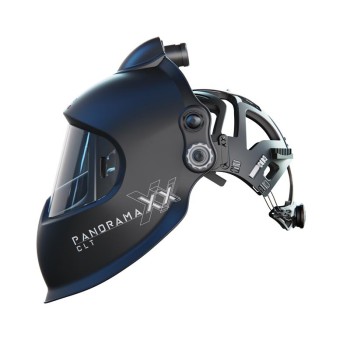
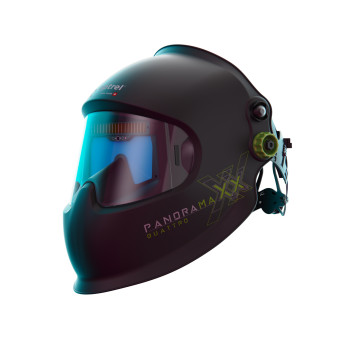
Optrel - Panoramaxx CLT black PAPR welding helmet

Supplier stock

Optrel

Reference: 4441.780

€878.61

738,33 € tax excl.

or 4 x 219,65 €

Free delivery

2-year warranty

This Optrel Panoramaxx CLT welding helmet features 5 sensitivity sensors.
Amperage adjustment range: up to 280 A.
The switching time of this helmet is 0.090ms at 20°C and 0.070ms at 55°C
The EN 379 classification of this model is: 1/1/1/2
Protection level (adjustable shade): 4-12 in automatic mode or 7-12 in manual mode.
Clear shade: 2 in grinding mode for maximum clarity
Weight 600 g
Temperature resistance: Welding helmet 220° and cover lens up to 137°
Suitable for MMA, MIG/MAG and TIG welding as well as plasma cutting. This helmet also features a grinding mode.
Suitable for overhead welding in constrained positions.


Delivered with:
a standard Isofit headgear, adjustable in height, width and length to fit all head shapes.
Storage bag
Micro USB charging cable
Cover lens
Warranty card.

PAPR connection equipment

2-year warranty with 1 additional year (excluding the accumulator) if the product is registered within the first 6 months after purchase on www.optrel.com.

favorite_border favorite
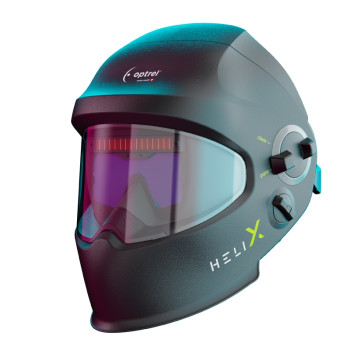
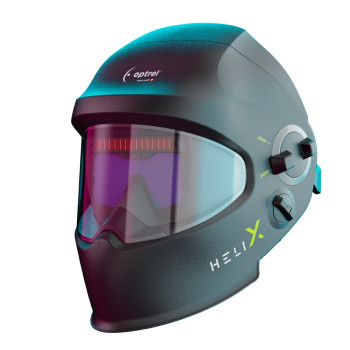
Optrel | Helix CLT black welding helmet

In stock

Optrel

Reference: 1050.210

(1 review)

€689.21

579,17 € tax excl.

or 4 x 172,30 €

Free delivery

2-year warranty

This Optrel HELIX CLT welding helmet with flip-up lens features 5 sensitivity sensors.
Amperage adjustment range: up to 280 A.
The switching time of this helmet is 0.090ms at 23°C and 0.070ms at 55°C
The EN 379 classification of this model is: 1/1/1/2
Protection level (adjustable shade): 4-12 in automatic mode or 7-12 in manual mode.
Clear shade: 2 in grinding mode for very high clarity
Weight 640 g
Temperature resistance: Welding helmet 220° and protective screen up to 137°
Suitable for MMA, MIG/MAG and TIG welding as well as plasma cutting. This helmet also features a grinding mode.
Suitable for overhead welding in constrained positions.


Delivered with:
a standard Isofit headgear, adjustable in height, width and length to fit any head shape.
Storage bag
Micro USB charging cable
Protective screen
Warranty card.

2-year warranty with 1 additional year (excluding the battery) if the product is registered within the first 6 months after purchase on www.optrel.com.

favorite_border favorite
Optrel - Helix Quattro black welding helmet

In stock

Optrel

Reference: 1050.110

€689.21

579,17 € tax excl.

or 4 x 172,30 €

Free delivery

2-year warranty

This Optrel Helix Quattro welding helmet with flip-up lens is suitable for welding in demanding conditions
Amperage adjustment range: up to 500 A.
The switching time of this helmet is 0.090ms at 20°C and 0.070ms at 55°C
The EN 379 classification of this model is: 1/1/1/1
Protection level (adjustable shade): 4-14
Clear shade: 3 for grinding work.
Weight 640 g
Temperature resistance: Welding helmet 220° and protective screen up to 137°
Suitable for MMA, MIG/MAG and TIG welding as well as plasma cutting. This helmet also features a grinding mode.
Suitable for overhead welding in constrained positions.


Delivered with:
a standard Isofit headband, adjustable in height, width and length to fit any head shape.
Storage bag
Micro USB charging cable
Protective screen
Warranty card.

2-year warranty with 1 additional year (excluding the battery) if the product is registered within the first 6 months after purchase on www.optrel.com.

favorite_border favorite
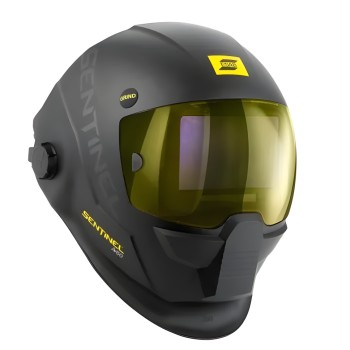
ESAB - Sentinel A60

In stock

ESAB

Reference: 0700600860

(18 reviews)

€391.71

329,17 € tax excl.

or 4 x 97,93 €

Free delivery

2-year warranty

High-performance automatic welding helmet. Sentinel A60 was designed with enhanced vision in mind.
Viewing area 40% larger than A50 (118 x 71 mm) for a wider view of your work.
Its new ADF offers excellent 1/1/1/1 EN optics from all angles
Ultra-clear True-Color lenses to reduce eye fatigue
Shade range from 3/5 to 13 adjustable in half-unit digital increments to optimise vision
4 overactive arc detection sensors for automatic brightness recognition in any work environment
Bright two-colour LED display for easy viewing in low-light conditions
New graphics to adjust sensitivity and delay time
Buttons carefully spaced apart from each other, easy to use even with gloves
ADF with nine programmable memory slots to save and quickly access welding profiles
Esab Sentinel A60 features an external grinding mode button for easy activation
New shade lock function to bypass the ADF and keep the helmet in its darkest state.
2 replaceable CR2450 lithium batteries with solar support
Internal warning indicators for grinding mode, low battery and ADF bypass lock
The signature flip-front design of the Sentinel A60 with infinite adjustment distributes weight
around the head.
Switching time (light to dark): 0.04 ms; switching time (dark to light): 0.1–0.9 s, adjustable


Approvals: CE: EN175, EN379, EN166; ANSI Z87.1; CSA Z94.3; AS/NZS 1337.1, 1338.1; TP TC 019/2011; ISO 16321-1/2

3-year warranty (battery excluded)

DELIVERED COMPLETE WITH 2 AMBER REPLACEMENT EXTERNAL PROTECTION LENSES, 2 CLEAR EXTERNAL PROTECTION LENSES, 2 INTERNAL PROTECTION LENSES AND A PRACTICAL PROTECTIVE CARRY BAG.

favorite_border favorite
Optrel - Panoramaxx Quattro black welding helmet

In stock

Optrel

Reference: 1010.100

(2 reviews)

€619.79

520,83 € tax excl.

or 4 x 154,95 €

Free delivery

2-year warranty

The Optrel Panoramaxx Quattro welding helmet features 5 sensitivity sensors.
Amperage adjustment range: up to 350 A.
The switching time of this helmet is 0.090ms at 20°C and 0.070ms at 55°C
The EN 379 classification of this model is: 1/1/1/1
Protection level (adjustable shade): 4-13
Light shade: 3 for grinding work.
Weight: 575 g
Temperature resistance: Welding helmet 220° and protective cover lens up to 137°
Compatible with MMA, MIG/MAG and TIG welding as well as plasma cutting. This helmet also features a grinding mode.
Suitable for overhead welding in constrained positions.


Delivered with:
a standard Isofit headgear, adjustable in height, width and length to fit any head shape.
Storage bag
Micro USB charging cable
Protective cover lens
Warranty card.

2-year warranty with 1 additional year (except for the battery) if the product is registered within the first 6 months after purchase on www.optrel.com.

favorite_border favorite
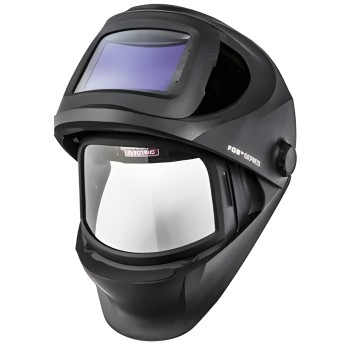
VIKING FGS 3250D K3540-3-CE Welding Helmet

In stock

Lincoln Electric

Reference: K3540-3-CE

(3 reviews)

€365.93

307,50 € tax excl.

or 4 x 91,48 €

Free delivery

2-year warranty

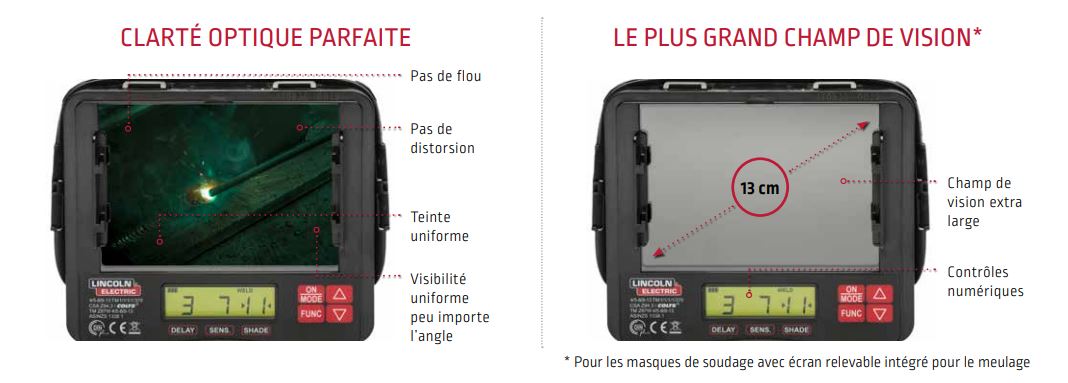
This auto-darkening welding helmet features 4 sensors with an integrated grinding screen with anti-fog coating
Operates with 2 CR 2450 lithium batteries. Equipped with a diode indicating the battery level.
Vision area: 75 x 108 mm.
Light/dark switching time: 0.000004 ms
Dark/light switching time: 10 positions from 0.1 to 1 second.
Sensitivity adjustment via digital button: 10 positions.
Adjustable shade from 9 to 13 for welding, from 5 to 8 for cutting.
Suitable for low-amperage TIG welding, microplasma, and oxy-acetylene welding

 Lincoln Electric's exclusive 4C technology liquid crystal display (LCD) increases the spectrum of visible colors. Unlike the traditional auto-darkening filter, 4C® technology broadens the range of visible colors and shades whether the light is diffuse or dark. It eliminates imperfections and color saturation, allowing you to clearly see the material being welded, the arc and the weld pool, while reducing eye fatigue.

VIKING FGS 3250D K3540-3-CE Welding Helmet

3-year warranty.

Optical class 1/1/1/1
Weight 793 g 

Supplied with:
5 outer protective lenses
2 inner protective lenses
1 sweatband
1 helmet cover
1 bandana

favorite_border favorite
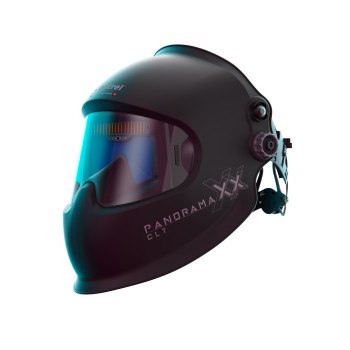
Optrel - Panoramaxx CLT black welding helmet

In stock

Optrel

Reference: 1010.200

(6 reviews)

€673.34

565,83 € tax excl.

or 4 x 168,34 €

Free delivery

2-year warranty

The Optrel Panoramaxx CLT welding helmet features 5 sensitivity sensors.
Amperage adjustment range: up to 280 A.
The switching time of this helmet is 0.090ms at 20°C and 0.070ms at 55°C
The EN 379 classification of this model is: 1/1/1/2
Protection level (adjustable shade): 4-12 in automatic mode or 7-12 in manual mode.
Light shade: 2 in grinding mode for maximum clarity
Weight: 600 g
Temperature resistance: Welding helmet 220° and protective cover lens up to 137°
Compatible with MMA, MIG/MAG and TIG welding as well as plasma cutting. This helmet also features a grinding mode.
Suitable for overhead welding in constrained positions.


Delivered with:
a standard Isofit headgear, adjustable in height, width and length to fit any head shape.
Storage bag
Micro USB charging cable
Protective cover lens
Warranty card.

2-year warranty with 1 additional year (except for the battery) if the product is registered within the first 6 months after purchase on www.optrel.com.

favorite_border favorite
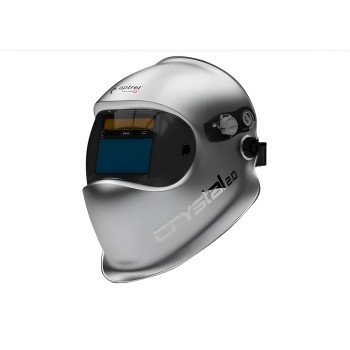
Optrel - CRYSTAL 2.0 silver welding helmet

Supplier stock

Optrel

Reference: 1006.900

€590.04

495,83 € tax excl.

or 4 x 147,51 €

Free delivery

2-year warranty

This Optrel CRYSTAL 2.0 welding helmet features 3 sensitivity sensors.
Powered by 2 x 3V CR2032 batteries.
The switching time of this helmet is 0.100ms at ambient temperature and 0.070ms at 55°C
The EN 379 classification of this model is: 1/1/1/2
Protection level (adjustable shade): 8-12.
Clear shade: 2 in grinding mode for maximum clarity
Weight: 482 g
Temperature resistance: Welding helmet 220° and cover lens up to 130°
Suitable for MMA, MIG/MAG and TIG welding as well as plasma cutting. This helmet also features a grinding mode.


Delivered with:
1 hard hat adapter
1 headband adjustable in width and length.
Storage bag
2 CR2032 batteries
1 spare outer cover lens
Warranty card.

2-year warranty with 1 additional year (excluding the accumulator) if the product is registered within the first 6 months after purchase on www.optrel.com.

favorite_border favorite
GYS LCD PANORAMIC 3XL Welding Helmet

In stock

Gys

Reference: 037281

(2 reviews)

€266.76

224,17 € tax excl.

or 3 x 88,92 €

Free delivery

2-year warranty

Essential for safety, the PANORAMIC 3 XL optoelectronic welding helmet protects the welder's face and eyes from UV, infrared, and spatter. Fully automatic, the mask switches from clear to shaded state in a fraction of a second, from the moment the arc is struck. Delivered with a headband, it frees the welder's hands and provides all the comfort needed for welding work.

UV/IR protection level: DIN 15
Shade: adjustable from 4 to 12 - True Color Technology
Classification: 1/1/1/1
Viewing area: 131 x 84 mm + 2x (67 x 75 mm) – Panoramic vision
Reaction time: 0.15 ms
Adjustments: sensitivity, shade, delay, memory
Power supply: solar + 2 CR 2450 batteries
Weight: 610 g
Standards: EN 175 / EN 379

Applications
MMA: 5 to 400 A
TIG: 2 to 250 A
MIG/MAG: 5 to 400 A
Grinding mode (Grind)

Consumables:
Outer lens 385 x 150 mm (ref. 037311)
Panoramic inner lens (ref. 037304)

As a welder, it is essential to practice your profession while taking care to protect your wellbeing. For this purpose, various protective accessories are recommended. Some are common across different crafts (gloves, safety glasses, etc.), while others such as welding masks are specific to welders. These accessories are very useful in welding practice, particularly to protect the eyes from sparks produced by the various welding processes. While the oldest versions of welding masks were handheld, today the situation is very different. There are dozens of variations, and the one that has been creating a buzz for some time is the panoramic welding helmet.

What is a panoramic welding helmet?

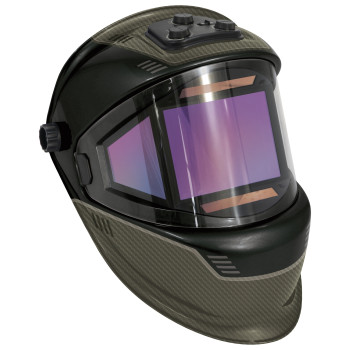
A mask or welding helmet is the protective equipment used in welding practice to shield the welder's eyes from UV and infrared rays. It also prevents metal splatter from reaching the face. Furthermore, panoramic welding helmets have some distinctive features. As implied by the name of this accessory, it offers a 180° panoramic view. The welder can thus carry out their various welding tasks without having to remove the mask to see laterally.

The advantages of the panoramic welding helmet

The wide field of vision provided by the welding helmet comes from its three windows, two of which are positioned on either side (left and right). The operator thus benefits from increased visibility thanks to a 180° field of vision. It is also worth noting that this type of mask features a headband that keeps the accessory in place and leaves the hands free.

Beyond this aspect, this welding helmet is equipped with technology that makes it automatic. This automation is based primarily on liquid crystal filters that darken instantly when the welding arc appears. When the arc stops, however, the mask lens becomes transparent again. This feature is not merely cosmetic, as it eliminates the cumbersome gesture of lifting and lowering the mask visor at every moment. This is made possible by an electro-optical device that electronically evaluates the light threshold the eyes can tolerate.

With its unique ergonomics, the panoramic welding mask is practical and offers great comfort of use to the operator. A key example: the sensitivity of the liquid crystal filter can be adjusted according to the welding process. Depending on the brightness of the piece, it is possible to externally adjust the delay time for the transition from the dark state to the clear state after the arc stops.

The different parts of a panoramic welding helmet

The panoramic welding helmet uses innovative elements to provide greater protection for the welder's face and eyes. Regarding eye protection, it is common practice to have masks with at least two layers of glass — one on the outside and one on the inside. The inner layer is generally a grinding visor onto which a removable section closes, with the field of vision in the center and a glass layer equipped with a liquid filter (filter lens). Thus, depending on the type of welding, the filter lens changes color. On top of this, there are 4 arc sensors whose role is to measure the intensity of the light produced by the welding arc in order to determine when to darken the visor of the welding helmet. Just near the sensors, there is a solar power source combined with lithium. Of course, a panoramic mask means peripheral vision — this is the defining feature of this welding protection mask model.

Some panoramic helmets are two-in-one accessories, as they also include respiratory protection. The usefulness of this option stems from the fact that welders face a 40% higher risk of lung cancer compared to other sectors. As a result, there are numerous mask variations to address this issue, including the powered air-purifying welding helmet and the ventilated panoramic helmet.

Selection criteria for a 180° welding mask

First and foremost, criterion no. 1 for choosing a panoramic helmet is certification. Indeed, a 180° helmet should genuinely be 180°. For this, the presence of peripheral visors is of course required. Beyond this point, the helmet must be examined to verify that it meets the standards. If a mask is not compliant, do not buy it. Also examine, before purchasing a panoramic helmet, the cell darkening speed as well as its arc sensitivity.

Please note that on certain panoramic mask models, the settings related to shade control or the grinding function may be internal. On others, however, these options are external. It is up to you to find the one that suits you. The next criterion to consider is the number of arc sensors. It is based on the condition of these sensors that the function which darkens or clears the helmet is operational or not. Therefore, the higher the number of sensors, the greater the chance that the regulation function will not fail.

Regarding the power supply of the accessory, you have three choices to make. You can opt either for a mask with a lithium battery (which can be replaced), or for a model powered solely by solar energy (equipped with a non-rechargeable backup battery). You can also opt for a mixed power supply. This power supply combines both lithium battery operation and solar energy operation.

Regarding external criteria, pay attention to the dimensions and weight of the welding helmet. There is no standard size or weight to determine a good mask. You therefore need to try it on to determine whether or not it suits you. At the same time, other criteria — secondary but important — should be examined. These include checking whether your helmet has an on/off selector as well as an anti-sweat band.

With these various criteria in mind, you are equipped as a professional or novice to determine the appropriate panoramic welding mask for your various tasks.

Why use a helmet for protection?

In order to weld two metals together, a high temperature is required. At a certain level, this temperature produces intense light. Thus, when welding is carried out without any protection, the intense light of the welding arc can cause irreversible damage to the operator's eyes. The face, meanwhile, could be exposed to potential splashes of molten metal.

Given these many risks, the obvious solution is the welding mask. It will protect you not only from visible radiation, but also from invisible radiation such as infrared and UV rays. The welding helmet will also protect you externally from skin burns and visible eye injuries.

To conclude this overview, please note that the welding mask is also useful for protecting the welder from the various fumes, vapors and gases produced by the different materials being worked on.

The difference from welding goggles

It is well established that both welding goggles and welding masks provide essential eye protection. However, goggles lose their effectiveness as light intensity increases. At that point, only welding masks can counter the effects of radiation. Unlike goggles, which only protect the eyes, welding helmets protect the entire face and extend down to the neck.

Traditional welding masks

Traditional welding helmets are those long used by professional welders of a certain era. Some still prefer it with its fixed-shade glass lens. This type of helmet has a permanently dark tint. Less expensive and more durable than panoramic welding masks, classic masks have several shortcomings. These shortcomings have been somewhat addressed in panoramic models.

Among these drawbacks, one is the cumbersome nature of the accessory for the welder whenever they want a clear view of the weld and the joint being made. They must also raise the visor each time they wish to begin welding or prepare their welding position. They are then forced to lower the visor each time they want to strike the arc. In addition to this frequent inconvenience, this movement can cause neck tension as well as significant fatigue at the end of the day.

This repetitive motion is even more frequent among novice welders whose technique is not yet fully developed. This will force them to frequently raise and lower their helmet to check whether the torch is properly positioned in the joint for striking. If the striking phase fails, the weld will be marred by welding defects, something no welder wants.