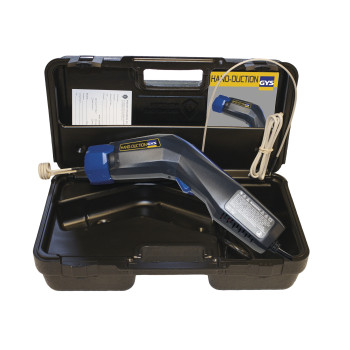
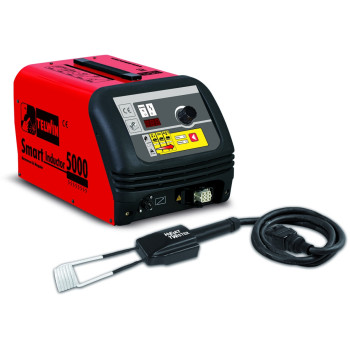
The induction machine heats metal via a magnetic field, without contact or flame. Used for induction brazing and certain induction welding operations, it offers localised, fast and clean heating. Discover our selection of professional induction machines.
The principle of induction
Induction welding is based on a high-frequency alternating current flowing through a coil (inductor). This current creates a magnetic field that heats the metal directly, without contact. The heat is localised, fast and controllable: the rest of the part remains cold, which limits distortion and thermal risks.
Induction brazing
The most common application of the induction machine is induction brazing: the area to be joined is brought to the melting temperature of the brazing alloy, which melts and fills the joint by capillary action. The result is a clean, reproducible and flame-free joint, ideal for copper, brass and other metals. Induction copper soldering is particularly widespread in plumbing and HVAC.
The advantages of induction
Compared to the oxyacetylene torch, the induction machine offers several advantages: rapid and localised heating, no open flame (increased safety), reproducibility of the heating cycle and process cleanliness. In production, the consistency and speed of induction often surpass flame-based processes.
Which metals and which tasks?
Induction welding is primarily concerned with the brazing of conductive metals: copper, brass, steel, stainless steel. It is used in plumbing, HVAC, industry and maintenance. The induction machine is also used for preheating, stress relieving and other targeted thermal operations, whenever heat must be localised without a flame.
Choosing the right machine
The choice of an induction machine depends on the power (proportional to the mass of metal to be heated), the frequency (suited to the thickness) and the available inductors. A properly sized machine equipped with interchangeable inductors covers a wide range of brazing and heating tasks.
Induction and productivity
The induction machine offers a major advantage in production: the reproducibility of the heating cycle. Each part receives exactly the same amount of energy, which guarantees consistent brazed joints in series. In comparison, torch heating depends on the operator and varies from one part to the next. For workshops that braze in quantity, induction reduces the reject rate and increases throughput.
Safety and cleanliness
The absence of an open flame is a considerable safety advantage of induction welding. No fire risk, no combustion residues, no flammable gas cylinder to manage. The working environment remains clean and safe. For workshops subject to strict safety constraints (industries, public buildings, confined spaces), the induction machine is often the only viable solution for brazing operations.
Inductors, the key accessories
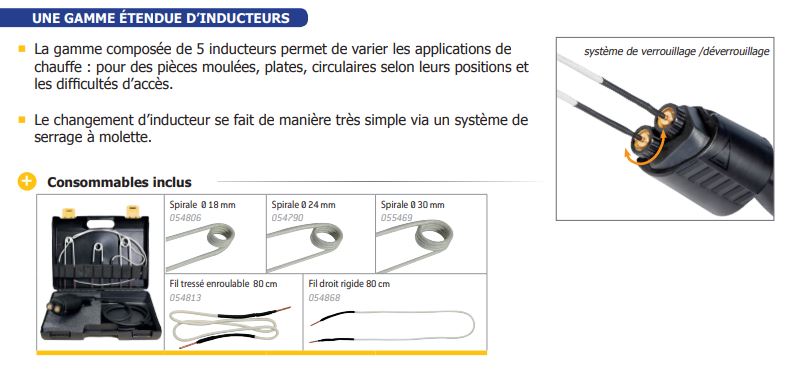
The effectiveness of the induction machine depends largely on the inductor used. The inductor is the coil that surrounds or approaches the part to be heated: its shape must match the geometry of the assembly. Interchangeable inductors allow a variety of configurations to be handled (tubes, fittings, plates). It is often the availability and variety of inductors that make the difference in the versatility of a machine.
Induction and copper
Induction copper soldering is the most widespread application of induction brazing, particularly in plumbing and HVAC. Induction heats the copper tube uniformly and rapidly, allowing the brazing alloy to flow by capillary action into the joint. The result is a clean, leak-tight and reproducible joint, achieved without a flame and without fire risk, even in sensitive environments. It is this combination of cleanliness, reproducibility and safety that makes the induction machine the reference tool for professional brazing of copper and other conductive metals.
For plumbing and HVAC workshops, the induction machine represents a notable gain in time and safety compared to the torch, especially in residential environments where an open flame is undesirable and where insurers impose precautions.
Our advice
For flame-free brazing and targeted thermal operations, the induction machine is the reference solution: fast, clean and reproducible. Size it according to the metals and masses to be treated, and check the availability of suitable inductors. Browse our selection of professional induction machines.
Frequently asked questions
How does an induction machine work?
A high-frequency alternating current flows through a coil (inductor) and creates a magnetic field that heats the metal directly, without contact or flame. The heat is localised, fast and controllable, limiting distortion.
What is the difference between induction brazing and torch brazing?
Induction heats without a flame, in a localised and reproducible way, with increased safety. A torch uses an open flame, which is simpler but less consistent. In production, induction often surpasses flame processes in speed and consistency.
Which metals can be brazed by induction?
Mainly conductive metals: copper, brass, steel, stainless steel. Induction brazing is very widespread in plumbing and HVAC for copper assemblies, but also applies to other metals in industry and maintenance.
How to choose an induction machine?
According to the power (proportional to the mass of metal to be heated), the frequency (suited to the thickness) and the available inductors. A properly sized machine with interchangeable inductors covers a wide range of tasks.


 Italy
Italy
 Netherlands
 Croatia
 Denmark
 Finland
 Greece
 Ireland
 Portugal
 Sweden
 Norway
 Bulgaria
 Estonia
 Latvia
 Lithuania
 Poland
 Czech Republic
 Romania
 Slovakia
 Slovenia
 Hungary
 Spain
Spain



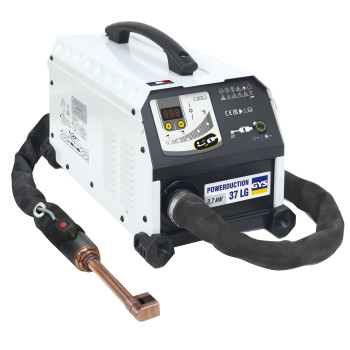
 2-year warranty