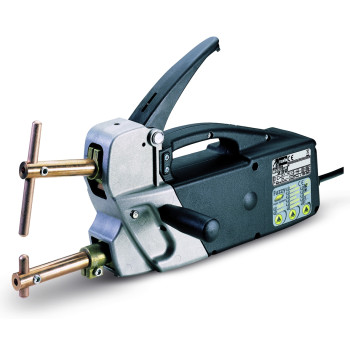
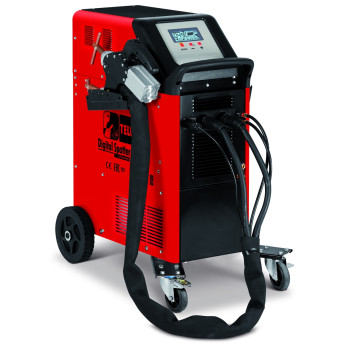
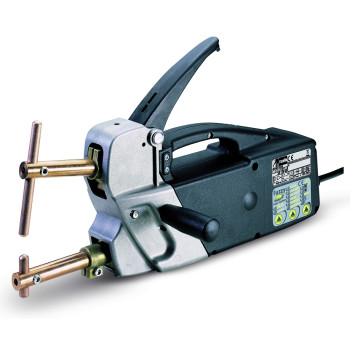
The spot welding machine joins two sheets by localized fusion, without filler metal or gas. Widely used in bodywork, the spot welder creates fast and clean weld spots between overlapping sheets. Discover our selection of spot welding machines for bodywork and sheet metal work.
The principle of spot welding
Spot welding relies on electrical resistance: two electrodes press the sheets against each other and pass a high current through them. The resistance at the contact point heats the metal to fusion, creating a weld spot. Spot welding requires neither gas nor filler metal, which distinguishes it from arc processes.
Why use a spot welder in bodywork?
The bodywork spot welder is the reference tool for joining thin sheets, particularly in automotive repair. It reproduces the original manufacturer weld spots, quickly and discreetly, without distorting or overheating the sheet as a poorly controlled arc process would. Bodywork spot welding ensures clean and compliant assemblies.
Clamp or arm: the configurations
Spot welding machines come in several configurations. The welding clamp, manual or pneumatic, presses the two sheets between its electrodes: ideal for areas accessible from both sides. Models with arms and interchangeable electrodes adapt to different bodywork geometries. The choice depends on access and the type of repair.
Choosing the right spot welding machine
To choose a spot welding machine, examine the power rating (which determines the weldable sheet thickness), the type of power supply, the ergonomics of the clamp, and the accessories (electrodes, arm). In bodywork, compatibility with thin sheets and modern steels is essential. Good electrode clamping is the key to a solid spot.
Spot welding or arc processes?
The choice depends on the assembly. The spot welding machine excels on thin overlapping sheets, in bodywork. For structures, greater thicknesses, or continuous beads, arc processes are used: MIG-MAG for productivity, MMA for versatility, or a professional automotive MIG machine for bodywork. Each process has its domain.
Safety and implementation
Spot welding generates high current and localized heat. Ensure good electrode contact, clean and well-prepared sheets, and wear appropriate protection: gloves and eye protection. Regular electrode maintenance (cleaning, reshaping) ensures consistent spots.
Preparing the sheets before spot welding
The success of a weld spot largely depends on preparation. The sheets must be clean, free of paint, rust, and filler at the spot location, and pressed firmly against each other. Poor contact or a dirty surface produces a weak or irregular spot. In bodywork spot welding, the location of the original spots is also respected to preserve the structural strength of the assembly.
Maintaining the spot welder electrodes
The electrodes of the bodywork spot welder wear and deform with use: their tips flatten, which distributes the current unevenly and degrades spot quality. Regular cleaning and reshaping of the tip maintain consistent and solid spots. Good tightening and alignment of the electrodes are also essential. Well maintained, a spot welding machine produces clean assemblies faithful to original standards, session after session.
Spot welding and modern bodywork
Repairing modern bodywork made from high-strength steels requires a spot welding machine capable of delivering the necessary power and clamping force. Faithfully reproducing the original spots is essential to preserve the structural strength of the vehicle, particularly on safety components. This is why the spot welder remains an essential tool in the bodywork workshop, alongside professional MIG machines for automotive use.
Our advice
For bodywork repair and joining thin sheets, the spot welding machine is the most suitable tool: fast, clean, and faithful to original assemblies. Choose the configuration (clamp or arm) according to your access needs, and check the power rating according to the sheet thickness. Browse our selection of spot welding machines and bodywork spot welders.
Frequently asked questions
How does a spot welding machine work?
Two electrodes press the sheets against each other and pass a high current through them. The electrical resistance at the contact point heats the metal to fusion, creating a weld spot, without filler metal or gas.
What is a spot welder used for in bodywork?
It joins thin sheets by reproducing the original manufacturer weld spots, quickly and discreetly, without distorting or overheating the sheet. It is the reference tool for automotive repair and bodywork spot welding.
What is the difference between a clamp and an arm-type machine?
The welding clamp (manual or pneumatic) presses the sheets between its electrodes, ideal for areas accessible from both sides. Models with arms and interchangeable electrodes adapt to different bodywork geometries. The choice depends on access.
When should spot welding be preferred over arc processes?
Spot welding excels on thin overlapping sheets, in bodywork. For structures, greater thicknesses, or continuous beads, arc processes are preferred (MIG-MAG, MMA). Each process has its field of application.
What is spot welding?
Spot welding joins two sheets by pressure and electric current. The heat is concentrated between the electrodes, creating a localized fusion point.


 Italy
Italy
 Netherlands
 Croatia
 Denmark
 Finland
 Greece
 Ireland
 Portugal
 Sweden
 Norway
 Bulgaria
 Estonia
 Latvia
 Lithuania
 Poland
 Czech Republic
 Romania
 Slovakia
 Slovenia
 Hungary
 Spain
Spain



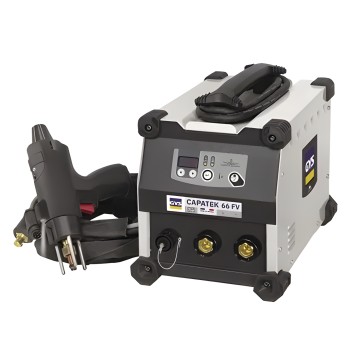
 2-year warranty