The column drill press is a machine tool long reserved for professionals that is now tending to open up to amateur DIY enthusiasts. Its role is to simplify drilling operations as much as possible and it is mounted on a base or a workbench. Thus, unlike other tools of its kind, the column drill press offers very high precision, particularly when drilling materials such as wood, plastic and steel. Beyond its incredible precision, this equipment has an impressive number of advantages. Would you like to know more about this tool, how it works and how to choose it? We provide more details in the rest of this article.
Presentation of the column drill press
The column drill press is not portable, unlike the rotary hammer, screwdrivers or percussion drills. To simplify its handling, it is fixed onto a support. Moreover, this distinctive feature has no impact since these different tools share the same basic functions.
Found mainly in workshops, the professional column drill press is usually mounted on a workbench and can also be floor-standing. Of course, the latter must depend on the weight and intended use of the tool and must be securely attached to its support. Just above the base, this equipment has a table whose purpose is to hold the workpiece on which drilling must be performed. It is also equipped with a lever to move the head consisting of the chuck and the drill bit.
Used in carpentry, metallurgy, and also in industry, this machine can drill wood, metal and plastic. It can also be used by DIY enthusiasts for home projects, provided the recommended safety measures are followed.
When should you choose this welding equipment?
Whether the device is intended for a modest craftsman in their workshop or for professionals on a construction site, for example, it is mainly used to work wood and metal. Thus, in general, the column drill press is used to accurately drill:
- Large-sized workpieces;
- DIY elements far from the edge of the workpiece;
- A structure or parts on a construction site.
How does it work?
As mentioned above, this tool has a column and a table that is fixed on bench models and movable on professional models. This element (the table) is the part on which the workpiece is placed and then held firmly in place using a vise. The electric motor of the device rotates a spindle holding a drill bit via a chuck. The diameter of the hole made by the machine depends on this drill bit. The entire operation is carefully controlled by a lever.
Also note that the reputation of drilling performed with a column drill press depends on the rotation speed. This speed in turn depends on the workpiece. For wood, for example, the drilling speed is set at a high level. Conversely, for plastic or metal parts, the drilling speed is reduced.
To illustrate this last point, a column drill press with a 650-watt motor is capable of drilling a part up to 13 mm in diameter. We therefore recommend a model whose motor power depends on the type of material you drill most often.
The advantages of a column drill press
We will begin our list of advantages with the fact that this machine allows you to keep both hands free. This is possible because, unlike conventional drills, column drill presses have their motor fixed to the column itself. It is thus possible to obtain perfectly straight holes, as well as an astonishing drilling quality.
With a column drill press, almost all drillings are successful. How? Thanks to the fact that the workpiece is held on the table. This allows better focus on the descent of the drill bit.
Although it is said that the column drill press is intended for professionals, it is no less true that it can also be used by amateurs. Very easy to pick up and use, everything relies on mastering the descent of the drill bit.
The different types of column drill presses according to their use
The column drill press is designed in several models whose functions are suited to their intended uses. Here is a mixed list of model types suited to both professionals and amateurs.
The bench column drill press
Very easy to use for drilling, it is compact and locks directly onto a table or similar furniture. This drill press is specially suited to less experienced DIY enthusiasts. It is not cumbersome and can easily find its place in a garden workshop.
The stationary model
Commonly called a floor column drill, this equipment, unlike the previous one, is much more suited to a professional workshop. That is indeed the primary purpose of its design. Being rather large, the stationary column drill press requires a significant portion of your workshop for installation. As indicated in its name, the floor column is obviously fixed to the floor and is endowed with very high power and drilling capacity.
The radial equipment
A cousin of the bench drill press, this model also shares similar characteristics. However, there is one distinctive feature. This tool can be equipped with a horizontal adjustment that gives the user the ability to adjust the distance between the chuck and the column. For construction professionals in particular, note that this device is ideal for drilling far from the edge.
The magnetic prototype
This is indeed a model designed for professional DIY users who are accustomed to working on the move. It provides significant drilling or milling flexibility, thanks in particular to its special system. Indeed, the magnetic model stabilises itself via an electromagnetic magnet on a flat metal surface.
In practical terms, how do you use this welding equipment?
To properly use a professional column drill press, these few steps may be useful to you:
- Wear the appropriate protective gear to avoid receiving chip splatter or other projections;
- Proceed with the installation of the machine and make sure it is securely fixed:
- Insert the workpiece into the vise and prevent it from moving;
- Choose your drill bit according to the material to be drilled and the desired diameter, then secure it in the chuck;
- Bring the table to the desired height and adjust it if it is movable until you reach optimal comfort, then lock it;
- Adjust the rotation speed of the device according to the material to be drilled and the diameter of the hole (a reduced speed produces holes with a larger diameter…);
- Check the condition of the power cord of the device and then plug it in
- Switch the tool on;
- Gradually bring the drill bit closer to the workpiece using the lever;
- Stop the motor once the hole is made;
- Remove the workpiece first and then the drill bit in order, and clean the machine.
For drilling a large-diameter hole, first make a small hole, then change the drill bit and perform the operation taking into account the final dimension of the hole.
Criteria for choosing a column drill press
Unlike most DIY tools, the criteria for choosing a column drill press are numerous.
The chuck
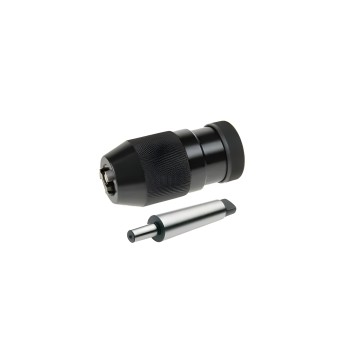
The chuck to opt for when seeking optimal comfort of use is the self-tightening one. In terms of installation, its distinctive feature is that it allows you to replace your drill bit without using any tool.
Speed
Make sure that the drill you choose has low and high speeds suited to your needs.
The laser sight
Opt for a machine equipped with one if you wish to perform tasks requiring very high precision.
The vise
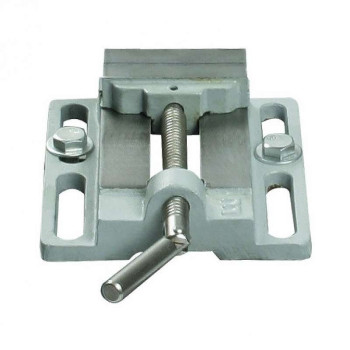
The choice of vise for your drill press depends on the workpiece to be clamped. Two types of vises are common on the market. The rod vise, which has the advantage of being lightweight, giving it excellent manoeuvrability, and the machined vise, which is admittedly heavy but will be your ally when performing frequent and intensive tasks.
The tilting and rotating table
Thanks to this parameter, the versatility and efficiency of your machine are increased.
Power
The diameter of the hole to be drilled will depend in part on the power of the drill press. A machine with a power of 650 W is suitable for drilling holes up to 13 mm. Note that the choice of your device based on its power will depend on the material to be worked.
The digital display
The presence of a digital display is generally found on high-end drill press models. This screen shows you precisely all the information relating to the drilling operation you are performing: drilling speed, depth, etc.


 Italy
Italy
 Netherlands
 Croatia
 Denmark
 Finland
 Greece
 Ireland
 Portugal
 Sweden
 Norway
 Bulgaria
 Estonia
 Latvia
 Lithuania
 Poland
 Czech Republic
 Romania
 Slovakia
 Slovenia
 Hungary
 Spain
Spain



 2-year warranty