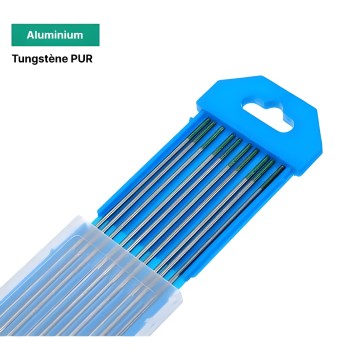
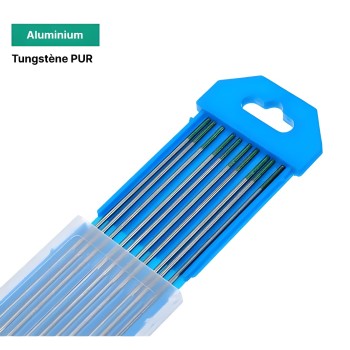
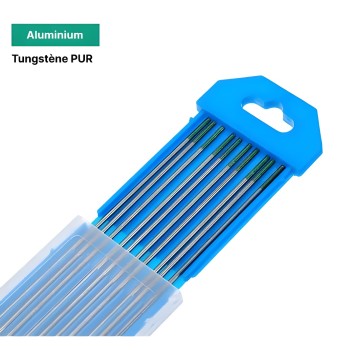
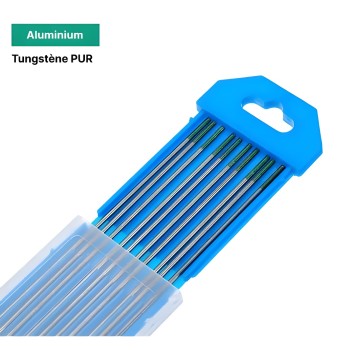
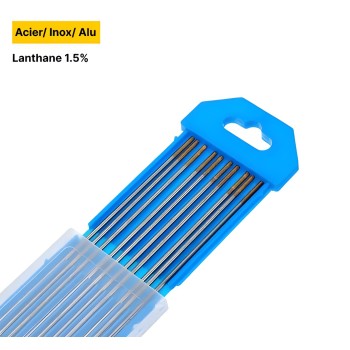
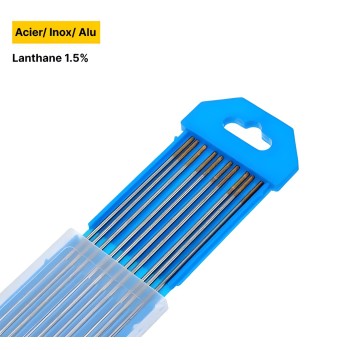
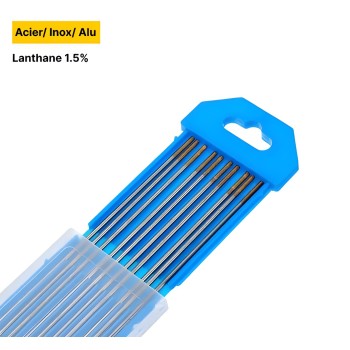
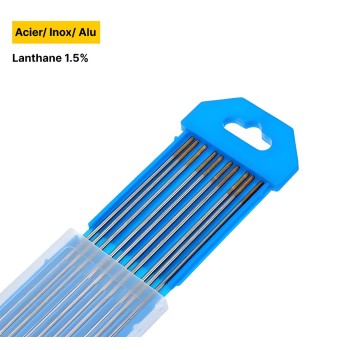
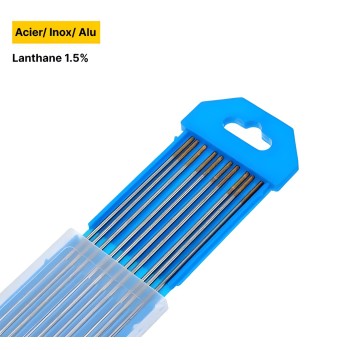
Tungsten electrodes are used for TIG welding. The very high melting temperature of Tungsten, around 3400 °C, allows an electric arc to be maintained between the workpiece and the electrode without wearing it out rapidly. Several types of electrodes exist, depending on the processes used. Standards EN26848 and ISO 6848 provide information relating to these electrodes. For TIG welding of aluminium, the pure tungsten electrode (green tip) is primarily used with alternating current. It allows a well-formed ball to be obtained at the tip of the electrode.
In our selection, we offer the best Tungsten electrodes perfectly suited for TIG welding of aluminium. They are available in packs, tested by our experts and validated by hobbyists and professional TIG welders. We only offer high-quality products from leading brands in the welding world. These are TIG electrodes for aluminium that have been specifically designed to improve dimensional stability at high temperatures, electron emission, forming, machinability and thermal conductivity.
The Tungsten electrode, the key component of TIG welding
TIG welding can be used to produce high-quality, clean welds on most materials, such as steel, stainless steel, aluminium and its alloys… The process uses an electric arc between a refractory tungsten electrode and the workpiece, while an inert gas shields the molten metal zone from ambient air during welding.
During TIG welding, a current is applied between the anode and the cathode, producing an electric arc that emits light. The tips of the electrodes must withstand temperatures ranging from 1800 to over 3400 °C. These tips dissipate heat towards the body of the electrode. Tungsten is the only metal compatible with these high physical and mechanical requirements. Tungsten has the highest melting point of all metals, low vapour pressure, low thermal expansion, good thermal conductivity and low electron emission.
For aluminium, pure Tungsten
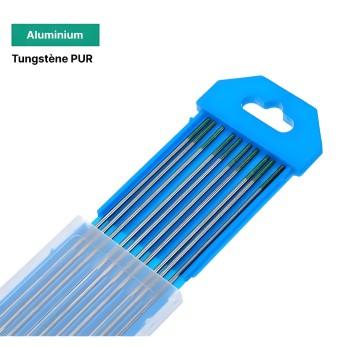
Pure Tungsten electrodes (green) are generally designed without additives for welding aluminium and its alloys with good arc stability. They allow a well-formed ball to be obtained at the tip of the electrode; this ball forms spontaneously within the first few seconds. However, zirconiated tungsten electrodes can also be used for manual welding on aluminium, magnesium and alloys at medium or low current intensity.
The tungsten electrode for aluminium welding is generally not sharpened. However, depending on the application and the welder's preferences, a 90° grind can be performed for welding light alloys such as aluminium. Unlike a pointed electrode, the ball shape at the tip of the Tungsten electrode for aluminium distributes the arc over a wider area. The formation of an appropriate electrode ball plays an important role, as the centre of the ball concentrates a partial arc to melt the weld joint. A uniform tip shape and a "bright" appearance are characteristic of good shielding and good welding practice.
It should be noted that the surface to be welded must be clean to avoid any contamination of the weld pool. To prepare the aluminium, it is preferable to use a stainless steel wire brush until the metal has a sufficiently "bright" appearance.
TIG welding of aluminium
While direct current (DC) is most frequently used in TIG welding, alternating current (AC) is reserved for welding aluminium. The alternating polarity breaks through the refractory alumina layer to allow penetration. However, direct current (DC) with straight polarity (negative pole at the electrode) can be used for welding all metals, including aluminium, but with certain precautions to be taken. For a good weld bead, welding aluminium and its alloys may require the use of a high-frequency generator with adequate characteristics. In the case of heavy oxidation, it is necessary to remove it by means of a wire brush or pickling (a chemical process to eliminate the oxide).
The following table summarises the types of current used for welding aluminium and its alloys.
|
Current type
|
Alternating current (AC)
|
Direct current (DCEP)
|
Direct current (DCEN)
|
|
Electrode polarity
|
Polarity alternation (50 Hz)
|
Positive polarity
|
Negative polarity
|
|
Application
|
The most commonly used and most suitable for aluminium
|
Very rarely used — Low current and very thin material
|
Used in very specific cases
|
|
Alumina cleaning effect
|
YES at each alternation (50 Hz)
|
YES
|
NO
|
|
Penetration
|
Medium penetration
|
Wide and shallow penetration
|
Narrow and deep penetration
|
|
Heat in the arc
|
50% in the welded workpiece
|
70% on the electrode
|
70% in the welded workpiece
|
|
50% on the electrode
|
30% in the welded workpiece
|
30% on the electrode
|
TIG AC/DC welding machine settings
On most TIG welding machines, the automatic wave balance mode can be used with Alternating Current (AC). The wave balance can be adjusted either more towards positive (cleaning effect) or more towards negative (better penetration). If the cleaning effect is increased, penetration decreases. Indeed, when more positive current is used, it is the electrode that absorbs the heat rather than the base metal.
When AC welding aluminium, the ratio between the positive and negative half-cycles is called the balance. Using the balance, you can control the heat between the electrode and the workpiece. When it is positive, it means the positive half-cycle is longer than the negative one, with heat more concentrated on the electrode than on the workpiece. In this case you obtain a wide bead with low penetration and a wide cleaned zone. Conversely, when the balance is negative, the negative half-cycles are longer, the workpiece is hotter and the electrode is cooler. In this case you obtain a narrow bead with deep penetration, but a narrow cleaned zone. In all cases, care must be taken to ensure that the current balance is not set to excessive cleaning, which can overheat and destroy the tip of the Tungsten electrode during the welding process.
As for frequency, when it is increased, the electric arc will be slightly more stable and narrower, but noisier. This provides better control for welding thin materials. A higher frequency can be used for thin sheets with a low current, while a lower frequency is generally used for thick sheets with a high current.
Permissible intensity for TIG welding of aluminium
In alternating current and depending on the diameter of the pure Tungsten electrode, the table below summarises the permissible intensities for welding aluminium.
|
Electrode diameter
|
Intensity
|
|
Ø 1.0 mm
|
10 to 50 A
|
|
Ø 1.6 mm
|
40 to 80 A
|
|
Ø 2.0 mm
|
60 to 110 A
|
|
Ø 2.4 mm
|
80 to 150 A
|
|
Ø 3.2 mm
|
100 to 200 A
|
|
Ø 4.0 mm
|
150 to 250 A
|
|
Ø 5.0 mm
|
200 to 350 A
|
Our TIG experts' tips
During aluminium welding, the tungsten electrode is struck by electrons during the positive half-cycle of the alternating current. If the diameter of the refractory electrode is not sized in relation to the welding current applied, the tip of the ball vibrates, rotates and disintegrates into the weld pool. Furthermore, the ball formed at the tip of the tungsten electrode must not be oversized, as it risks shattering into the weld pool at the slightest contact with the filler metal. If necessary, change the tungsten electrode diameter.
The tip of the non-consumable tungsten electrode must also protrude sufficiently from the nozzle to clearly see the electric arc and the weld pool. You can extend it between 2 and 2.5 times the diameter of your electrode without causing gas shielding problems.
Once again, it is essential to thoroughly clean and mechanically degrease the surface of your workpieces before starting a welding operation. Indeed, this tedious cleaning operation is often forgotten or poorly carried out, but the aluminium oxide layer must be removed as much as possible — it is a guarantee of quality work. Attempting to weld on dirty surfaces (presence of oxide, paint, grease, moisture) or poorly cleaned ones generates many defects, poor welds and various problems.
Frequently asked questions
What type of tungsten is used for aluminium?
For aluminium in TIG AC, a lanthanated, ceriated or zirconiated tungsten electrode is often used depending on the machine and personal preference. The diameter is chosen according to the current intensity.


 Italy
Italy
 Netherlands
 Croatia
 Denmark
 Finland
 Greece
 Ireland
 Portugal
 Sweden
 Norway
 Bulgaria
 Estonia
 Latvia
 Lithuania
 Poland
 Czech Republic
 Romania
 Slovakia
 Slovenia
 Hungary
 Spain
Spain



 2-year warranty