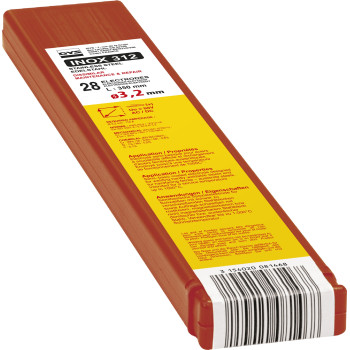
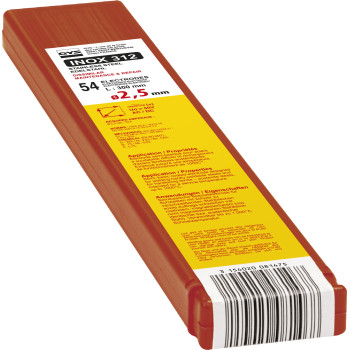
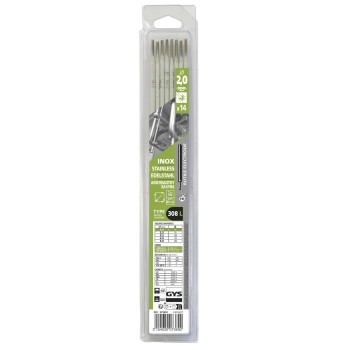
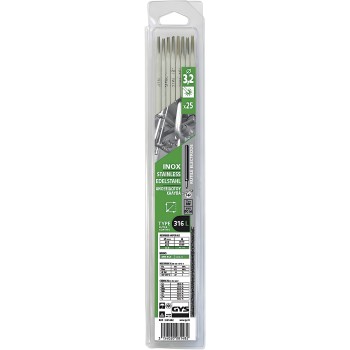
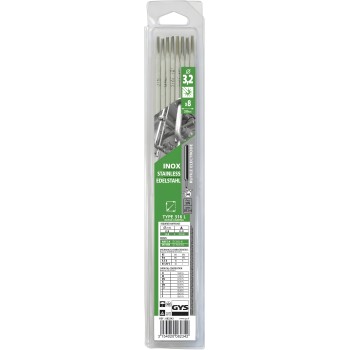
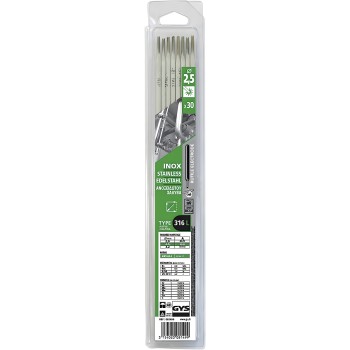
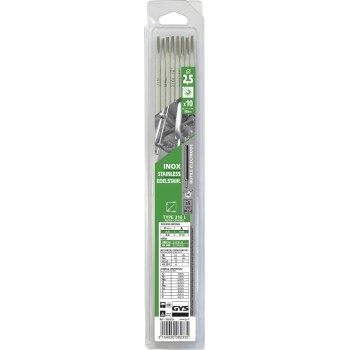
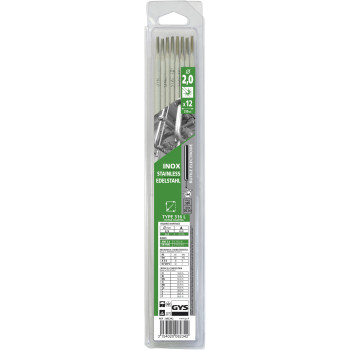
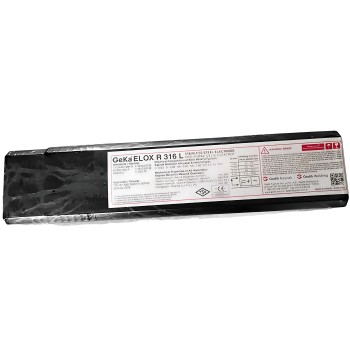
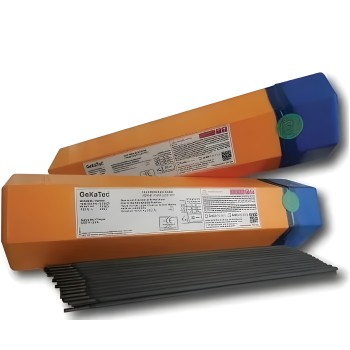
The stainless steel welding rod is the essential consumable for welding stainless steel with a coated electrode (MMA). These specific stainless steel electrodes enable corrosion-resistant welds to be made, even outside the workshop. Discover our selection of stainless steel welding rods, in the grades and diameters suited to your work.
Why use a specific electrode for stainless steel?
Stainless steel does not weld like ordinary steel. It conducts heat less efficiently, distorts more, and risks losing its corrosion resistance if heat input is poorly controlled. A dedicated stainless steel electrode provides a compatible grade (often 308L, 309L, or 316L) that preserves the properties of stainless steel. Using an ordinary steel rod on stainless steel would completely compromise the corrosion resistance of the weld bead.
Arc welding stainless steel
Arc welding stainless steel (MMA) is the most practical solution for repairs and on-site work where TIG is not available. The process is less aesthetically pleasing than TIG, but it gets the job done effectively. All you need is an MMA welder and stainless steel welding rods kept thoroughly dry. The result, with a well-chosen grade, is a strong and durable weld.
Choosing the right grade
The choice of stainless steel electrode grade depends on the stainless steel being welded. For grade 304 stainless steel (the most common), a 308L rod is suitable. For grade 316 stainless steel, which has greater corrosion resistance, a 316L is chosen. Grade 309L is useful for joining stainless steel to plain steel or for difficult stainless steels. The "L" designates a low carbon content that reduces the risk of intergranular corrosion around the weld bead.
The right diameter
The diameter of the stainless steel welding rod is chosen according to the thickness and the welder's amperage. A 2.5 mm stainless steel welding rod suits medium thicknesses and standard welders, while smaller diameters (1.6; 2.0 mm) are reserved for thin sheet metal and low amperages. The usual guideline: approximately 30 to 40 amps per tenth of a millimetre of diameter.
Controlling heat input
The success of a stainless steel arc weld depends on heat management. Excessive heat input distorts the stainless steel and destroys its corrosion resistance (the "chromic burn" phenomenon). Work in short beads, allow cooling between passes, and avoid contaminating the stainless steel with tools previously used on carbon steel: use a dedicated stainless steel brush.
Post-weld finishing
After welding stainless steel, the bead often has a coloured oxidised layer. A stainless steel treatment by pickling and passivation restores the passive chromium layer and the metal's appearance, ensuring its long-term corrosion resistance. This step is essential for exposed or food-contact parts.
Electrode storage
Like all coated electrodes, stainless steel rods are sensitive to moisture. A damp electrode generates porosity and cracks. Store your rods in their packaging, in a dry place, and use a drying oven for basic electrodes. A quality electrode holder completes the setup.
MMA, TIG, or MIG for stainless steel?
The choice of process depends on the desired finish and the context. The stainless steel welding rod with coated electrode (MMA) is the portable and economical solution, perfect for on-site repairs. TIG offers the best finish, spatter-free, ideal for visible sheet metalwork, food-contact applications, and decoration. MIG with stainless steel wire and gas favours productivity on thicker parts. For arc welding stainless steel, MMA remains the simplest to implement: no gas, no spool, just a welder and dry stainless steel electrodes. Whatever process is chosen, controlling heat input and keeping tools clean (dedicated stainless steel brush) remain the two fundamentals of a successful stainless steel weld.
Our recommendation
To arc weld stainless steel, choose a stainless steel welding rod of the correct grade (308L, 316L, or 309L as appropriate) and the right diameter, keep it thoroughly dry, and control your heat input. For a superior finish, the TIG process remains the benchmark, but MMA works anywhere. Browse our selection of stainless steel electrodes and complete your equipment for strong, durable welds.
Frequently asked questions
Which rod should be used for arc welding stainless steel?
A stainless steel coated electrode of the appropriate grade: 308L for grade 304 stainless steel, 316L for grade 316 stainless steel, 309L for joining stainless steel and plain steel. The rod must be kept thoroughly dry. With an MMA welder, you get a solid weld, ideal for on-site repairs.
What is the difference between a 308L and a 316L electrode?
The difference lies in the grade: 308L suits grade 304 stainless steel (the most common), while 316L, with greater corrosion resistance, is intended for grade 316 stainless steel. The electrode is chosen according to the grade of stainless steel being welded, in order to preserve its corrosion resistance.
What diameter stainless steel rod should I choose?
Depending on the thickness and the welder's amperage: 2.5 mm suits medium thicknesses and standard welders, while smaller diameters (1.6; 2.0 mm) are for thin sheet metal and low amperages. A useful guideline: approximately 30 to 40 amps per tenth of a millimetre of diameter.
Can stainless steel be welded with an MMA welder?
Yes, with specific stainless steel coated electrodes. It is the most practical solution for on-site repairs where TIG is not available. The result is less aesthetically pleasing than TIG, but the weld is solid if the grade and heat input are well controlled.


 Italy
Italy
 Netherlands
 Croatia
 Denmark
 Finland
 Greece
 Ireland
 Portugal
 Sweden
 Norway
 Bulgaria
 Estonia
 Latvia
 Lithuania
 Poland
 Czech Republic
 Romania
 Slovakia
 Slovenia
 Hungary
 Spain
Spain



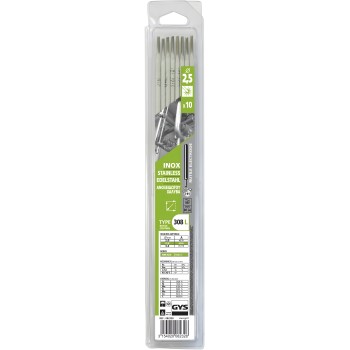
 2-year warranty